Quality Assurance for Additive Manufacturing
nLIGHT plasmo provides deep insights into the respective components with its quality assurance solutions.
Our customers use the associated freedom in component design as well as the rapid feasibility in prototype construction with additive processes. Additive manufacturing with metals or plastics offer companies new possibilities with a high degree of geometric flexibility. In order to make optimal use of the manufacturing process in series production, essential prerequisites must be fulfilled.
In addition to an understanding of the manufacturing processes, knowledge of achievable possibilities, component direction-dependent mechanical-technological properties and the application of suitable quality assurance systems is indispensable. In this way, defective parts can be detected when they occur. The additive processes are used in sectors such as aviation, energy technology, petrochemical, automotive, tool- and mold making, and medical technology.
nLIGHT plasmo’s many years of experience in the field of thermal joining processes can be transferred to additive manufacturing applications. The special adaptation of the QA systems for additive manufacturing has been developed and implemented at plasmo since 2010 and supported in many cooperation projects with industrial and scientific partners.
Our quality assurance systems support customers to not only provide the necessary safety but also offer many other advantages such as the reduction of testing costs. This contributes to nLIGHT plasmo’s clear vision for the future: to develop new concepts together with system manufacturers for the two application areas of Powder Bed Fusion and Direct Energy Deposition. In addition to more intelligent construction processes (e.g. feedforward control), nLIGHT plasmo is working with system manufacturers and the scientific community on the faster, sustainable qualification of processes and their standardization.
Additive processes PBF and DED
Additive manufacturing processes can be divided into powder bed-based processes (Powder Bed Fusion/PBF) and direct energy deposition (DED) processes – e.g. laser metal deposition or wire-based processes. Which manufacturing process is used depends, for example, on the size of the structures of the components. PBF enables smaller structures with smaller volumes while DED processes usually enable larger volumes with higher application/deposition rates.
Due to the complexity of the tasks in both 3D printing processes, quality assurance is important and is a standard requirement for many companies. Quality criteria such as strength, dimensional accuracy, and surface quality can, depending on process parameters and requirements, be comparable in both processes. However, the different manufacturing processes require different QA systems based on the same physical principles.
Quality assurance for deposition welding (DED)
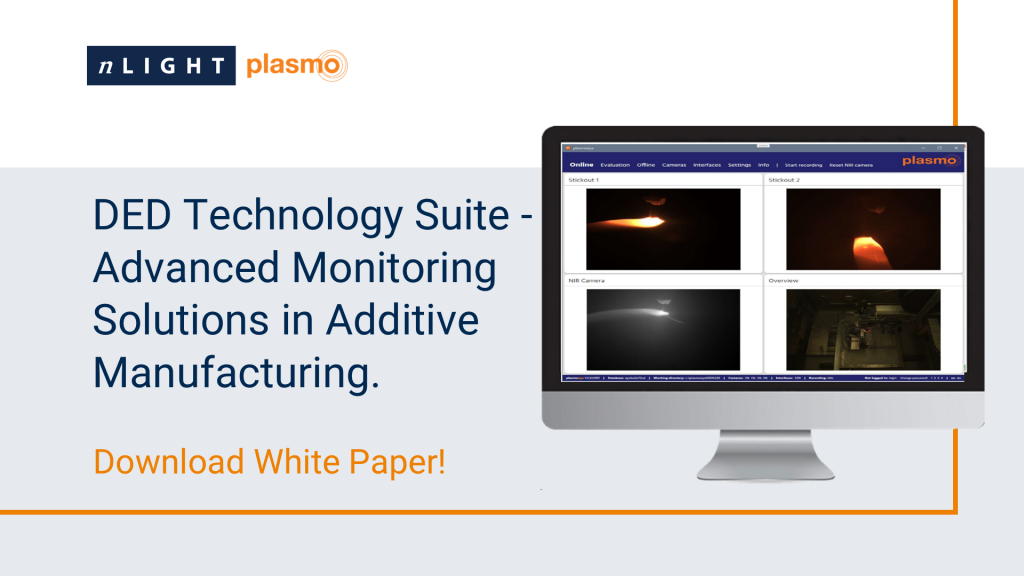
In the Direct Energy Deposition process, nLIGHT plasmo systems enable the detection of process irregularities through sensor- and camera-based technologies. Furthermore, processing positions as well as plant and process parameters are recorded.
The processobserver records the process emissions in the visible and near infrared range and thus enables the detection of errors or deviations.
The camera-based system plasmoeye enables the visual representation and documentation of the DED process in real time, whereby parameters from the melt pool and/or other geometrical parameters are determined. Using cameras in the near infrared range, temperature distribution and cooling in the solidified area are evaluated in order to draw conclusions about the quality. Furthermore, possibilities for closed-loop control are developed by recording the IR spectrum.